

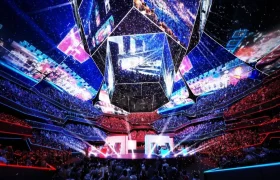
While baseball argues about pitch clocks, E-sports are reinventing the very concept of live entertainment. The future isn’t a TV broadcast; it’s a Twitch stream.
If you want to see the future of sports broadcasting, don’t watch the Super Bowl. Watch the League of Legends World Championship. Traditional sports are obsessed with “inches”—the ball crossing the line, the foot on the base. But E-sports are measured in pixels and milliseconds. They have built an ecosystem that is faster, more interactive, and infinitely more data-rich than anything on cable TV.
For a generation raised on the internet, traditional sports feel slow and disconnected. They are “lean-back” experiences (sitting on a couch), while E-sports are “lean-forward” experiences (typing in chat, checking stats, multitasking). To survive, traditional sports must stop treating E-sports like a quirky cousin and start treating them like a mentor. This article explores the precise measurements of engagement that E-sports have mastered and how the old guard can adapt.
The UI is the Stadium
In E-sports, the User Interface (UI) is everything. The screen is packed with information: mini-maps, cooldown timers, gold counts, and health bars. The viewer is constantly processing data. Compare that to a soccer broadcast. For vast stretches of time, there are no graphics on the screen. Just green grass.
The modern fan craves information density. They want to measure the performance in real-time. We are starting to see this shift with “alt-casts” like the NFL’s “Next Gen Stats” feed, but it is still primitive compared to the native data integration of a Twitch stream. The screen estate is valuable real estate; leaving it empty is a wasted opportunity to engage the analytical brain of the viewer.
The Power of “Co-Streaming”
The biggest innovation in E-sports is “Co-streaming.” This is where a popular streamer watches the official broadcast with their audience, providing their own commentary. It turns the broadcast into a hangout. You aren’t listening to a polished professional in a suit; you are listening to a gamer in a hoodie who makes jokes and reads your chat messages.
This authenticity is magnetic. It measures engagement not in ratings, but in chat density. Traditional sports are slowly adopting this. The “ManningCast” on Monday Night Football is a direct copy of the Twitch model. It creates a relaxed, community-focused vibe. Platforms that embrace this “chill” aesthetic—like those identified by the keyword talonchill.com—are tapping into this exact psychology. They offer a viewing experience that feels less like a corporate lecture and more like a living room gathering. They measure success by the “vibe” of the community, ensuring that the environment is stable enough to support both the high-definition stream and the casual social interaction that defines modern fandom.
The Chat Room as the Roar
In a physical stadium, you measure excitement in decibels. In a digital stadium, you measure it in “Chat Velocity.” When a big play happens on Twitch, the chat scrolls so fast it becomes a blur of emotes. This is the “digital roar.” It validates the viewer’s emotion.
Traditional sports apps are often sterile. They lack this communal feedback loop. By integrating live chat directly next to the video player, sports apps can replicate the feeling of being in a crowd. It turns a solitary mobile viewing experience into a collective event.
Accessibility vs. Exclusivity
E-sports are largely free to watch. The business model is built on micro-transactions (skins, bits, subscriptions) and sponsorship, not paywalls. Traditional sports rely on expensive cable bundles. This creates a barrier to entry for young fans. If you make it hard to watch, people will find other things to do. E-sports understand that access creates addiction.
This is why the search volume for 축구무료중계 (free soccer broadcasting) is so high among younger demographics. They are used to the open-access model of Twitch and YouTube. They approach sports with the expectation that content should be available. When they find portals that offer this access without the friction of a credit card, they stay. The industry must measure the long-term value of a free user (who might buy merchandise later) versus the short-term value of a gated subscriber.
Gamification of the View
Finally, E-sports gamify the act of watching. Viewers earn “Channel Points” just for keeping the stream open. They can use these points to highlight their messages or unlock rewards. Imagine if you earned loyalty points for watching every inning of a baseball team’s season, which you could then trade for a ticket discount. That is the level of integration E-sports have achieved.
The Precision of Evolution
The gap between E-sports and traditional sports is narrowing. The “inch” is meeting the “pixel.” The sports that will dominate the next decade are the ones that can measure what matters: not just how many people are watching, but how deeply they are connected. The tools are there. The blueprint is on Twitch. Now, it’s time for the old dogs to learn some new clicks.
